
Why is the use of AI without an agency OS futile?
Many agencies are investing heavily in artificial intelligence. But without a robust agency OS — i.e. an agency operating system — the economic effect often fails to materialise.

Why using AI without agency OS comes to nothing
Many agencies are investing heavily in artificial intelligence. But without a robust agency OS — i.e. an agency operating system — the economic effect often fails to materialise.
The euphoria is palpable. Hardly any presentation, hardly any strategy discussion in the agency industry is currently without reference to artificial intelligence. Text generators write campaign drafts in seconds, image models produce visuals at the push of a button, transcription tools automatically structure customer conversations. AI is seen as an answer to margin pressure, a shortage of skilled workers and increasing efficiency requirements.
The technological capacity is undisputed. Yet there is a contradictory picture in many agencies. Despite AI integration, operational complexity is increasing, coordination costs remain high, and economic leverage is lower than expected.
The reason is rarely in the quality of the models. It lies in the organization that uses them.
Acceleration does not replace an operating system
Artificial intelligence accelerates individual work steps. It generates texts, analyses data, and develops image ideas. But it does not organize any processes. It does not define any responsibilities, does not standardize approvals and does not create any structural transparency.
In many agencies, AI meets established tool landscapes: project management software, cloud storage, social media planners, reporting tools, CRM systems. There are also individual folder structures, chat histories and email chains. Knowledge and responsibility are distributed, often tied to individuals and only partially documented.
When integrated into such an environment, AI accelerates existing processes — but not their structure. Content is created faster, but must continue to be coordinated, corrected and coordinated. Output increases, friction persists.
But productivity is more than speed. It is the result of a coherent system architecture.
The promise of the “Agency Brain”
Parallel to the AI debate, another concept has become established: the so-called “agency brain.” What is meant is a central knowledge base in which customer history, strategy papers, tonalities, contract content and performance data are bundled. The underlying assumption is understandable: The more comprehensive the context, the more precise the AI results.
In practice, however, this context is rarely centralized. Information is stored in CRM, in the project management tool, in cloud folders, in video conference transcripts, or in personal notes from individual employees. AI systems usually only access a fraction of this knowledge.
The result is generic suggestions that need to be sharpened. The efficiency gain remains limited.
But even a central knowledge database is no guarantee of scaling. Knowledge is a prerequisite, but it is not yet an organizational model.
Knowledge is created in processes
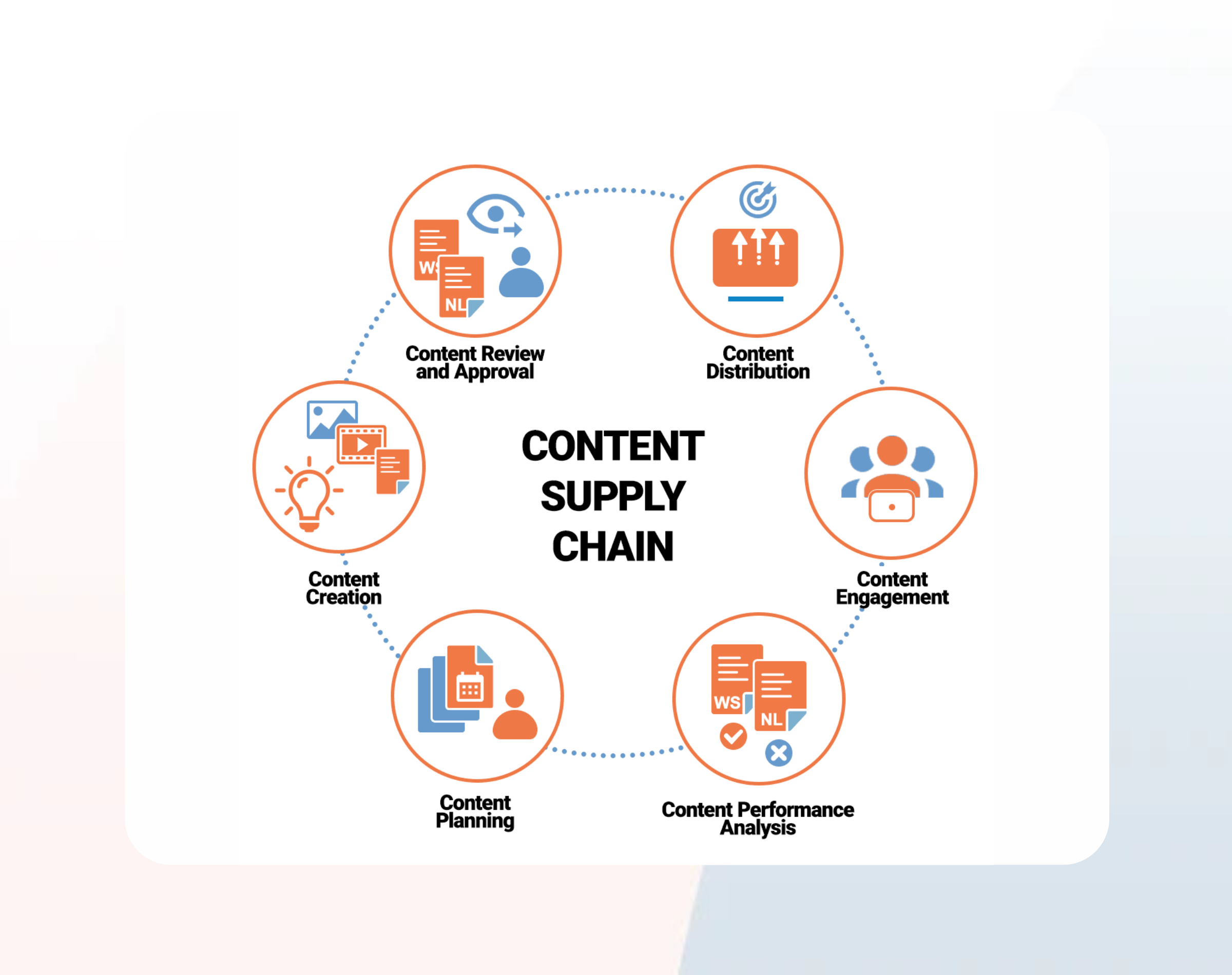
A resilient “agency brain” is created not by introducing an additional tool, but by systematically organizing content operations. Content must be versioned, responsibilities clearly defined, approvals structured and customer contexts must be cleanly separated. Histories must be comprehensibly documented so that strategic decisions do not start from scratch.
Only when knowledge is created continuously within standardized processes is a consistent knowledge architecture formed. Without this embedding, even an extensive collection of data remains fragmented.
The decisive difference therefore lies between tool integration and system architecture.
Scaling is a question of structure
Against the backdrop of economic uncertainty, the question of scalability is taking center stage. How can more output be generated without proportionally building up personnel? How does quality remain stable when customer numbers grow or teams expand?
Scaling doesn't mean working faster. It means making performance reproducible — independently of individual people. This requires clearly defined roles, standardized workflows, consistent quality mechanisms and integrated publishing structures.
Artificial intelligence cannot replace these elements. It can only reinforce them. When it meets an uncoordinated setup, it speeds up clutter. When it meets a well-thought-out operating model, an economic lever is created.
From tool debate to architecture debate
In the long term, the discussion in the industry is likely to shift. It is not the question of which AI model is used that will be decisive, but which structured knowledge and process architecture this model accesses.
Agencies that systematically organize their content operations create the basis for contextual AI — i.e. for systems that not only process isolated prompts, but can also draw on complete customer histories, strategic guidelines and operational logic.
As a result, competition is shifting. It is no longer just tool expertise that counts, but system expertise.
Without a reliable operating model, artificial intelligence remains an efficiency promise
Artificial intelligence is no substitute for structure. It is an amplifier. Its economic benefits depend less on the performance of the models than on the organizational architecture in which they are embedded.
Agencies that see AI as an isolated efficiency tool risk increasing complexity without a corresponding margin improvement. On the other hand, anyone who first clarifies their operating model and systematically organizes knowledge creates the conditions for AI to actually develop its potential.
The future of the industry is therefore decided not only by the question of technology, but by the quality of its organizational models.