

Content supply chain ensures systematic content production
Demand for content is growing rapidly, and the sheer volume and complexity of content presents companies with comprehensive challenges. How can you enable continuous planning, delivery, and optimization of content without overwhelming the responsible teams with large, frustrating coordination efforts?
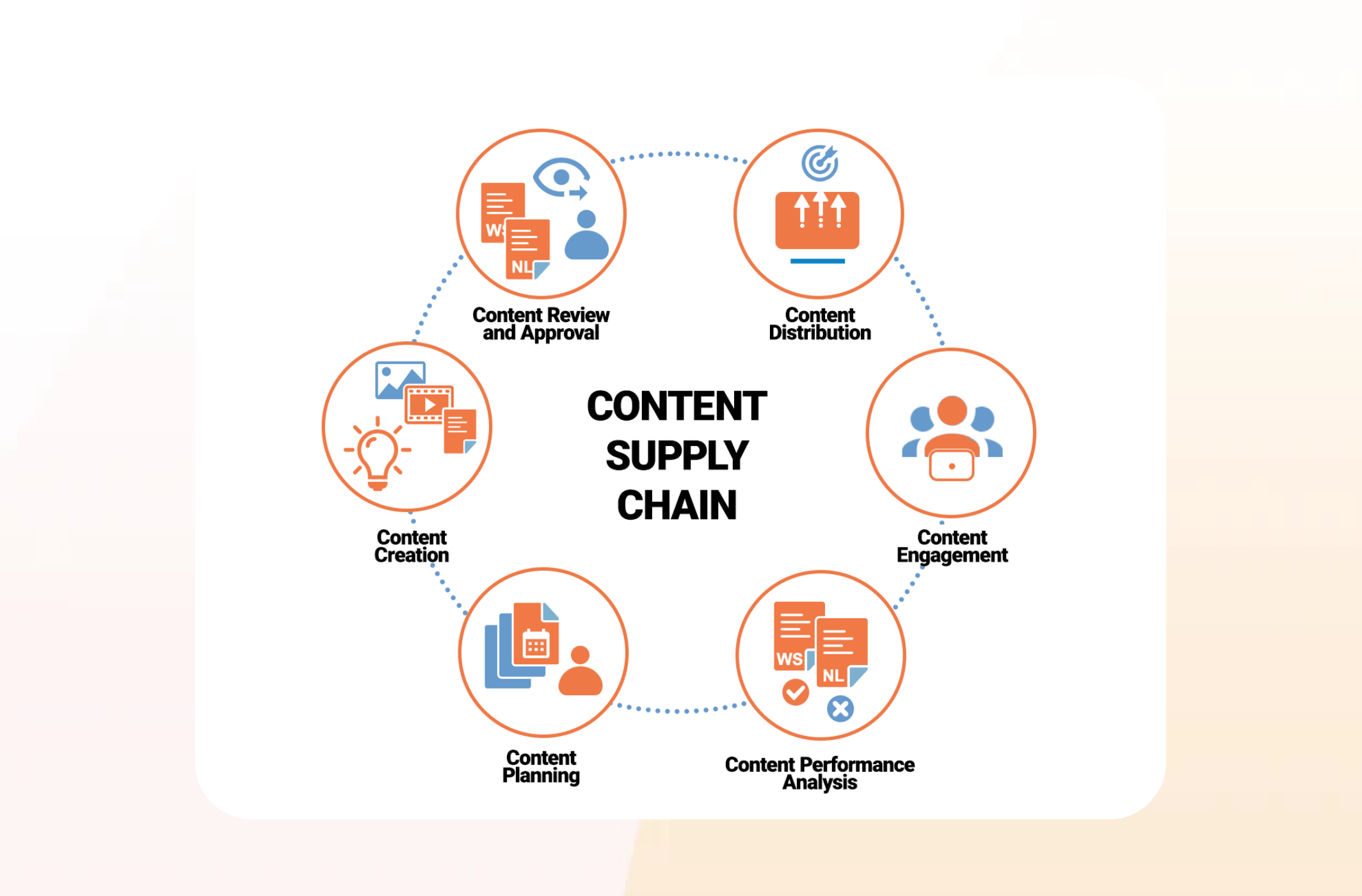
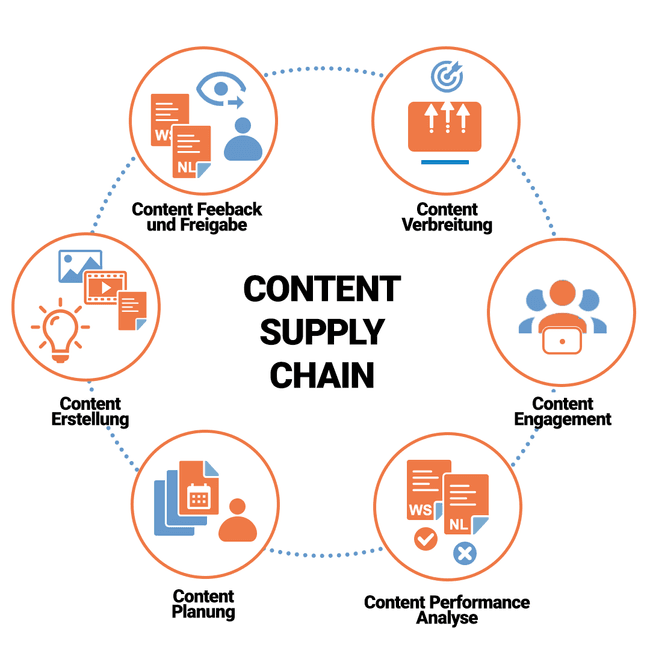
That's where the content supply chain comes in — a systematic approach to managing the entire content life cycle, from planning and creation to distribution and analysis.
What is a content supply chain?
A content supply chain (CSC) is a business process that involves planning, creating, managing, and delivering content. It is comparable to a traditional supply chain, in which raw materials are converted into a finished product and delivered to the end customer. In the content supply chain, however, digital content such as texts, images and videos is converted into publication-ready formats through various steps and actors and distributed across various channels.
Working with content always involves a variety of people who all perform different tasks but work towards a common goal: providing content for successful customer experiences.
The key players are:
- client: Product managers who want to make their product known; brand managers who want to strengthen their brand; event managers who want to draw attention to their event; communication managers who want to set topics.
- Creatives: Are responsible for creating images, video, sound and text and are in a constant process of generating ideas, implementing and revising them with their clients.
- Administrators: These specialists advise clients on what is desired and feasible and, together with the creative people, drive implementation forward as efficiently as possible in order to provide the content of the expected quality at the agreed time.
- Publishers: Receive the checked and approved content for publication in various channels, whether in digital channels such as websites, newsletters and social media or in classic communication products such as brochures, posters, stands and the like.
- Analyzing: Check whether the content developed has achieved the desired goals and use collected or generated data to investigate where future optimizations should start.
The large number of players is already showing that the complexity of the content production process is high and therefore also susceptible to errors and idle times. The ongoing coordination is then accompanied by extensive administrative work, which is often perceived as unsatisfactory for those involved.
How can a content supply chain strategy be mapped in a company?
Software solutions designed for this purpose are required to coordinate the various steps of content production and to organize cooperation. The aim is to minimize the number of solutions used in order to enable the actors involved to work together seamlessly.
As part of digitization, digital asset management systems have been established, which are optimized for the provision of image, sound and video content. However, these systems no longer do justice to the increasingly differentiating media landscape. In the vast majority of cases, Content 2.0 is a combination of digital assets with texts and meta information, such as keywords, hashtags or thematic assignments, for finding the content in the company's inventory. These combinations are growing exponentially as a result of progressive personalization and localization, which continues to increase complexity.
Content operations systems such as Scompler, Contentbird or ContentPaul Go one step further and enable companies to capture, store and recycle their entire content in various dimensions. In contrast to solution providers such as Adobe, which combine their numerous offerings for specific tasks into an integrated content supply chain, content operations systems are built natively as content supply chain solutions and enable users to comprehensively represent their content — from content to assets to the thematic and time planning of all communication measures.
Why does my company need a content supply chain strategy?
There are many reasons for a content supply chain strategy. These relate, on the one hand, to the content strategy in the company and, on the other hand, to organizational simplifications of the production process.
Control over communication and brand personality
In companies, the various channels are also often divided organizationally. There is the web team, the social media team, the newsletter team and the team for tactical measures or campaigns. Because of the specific technical definitions of their channels, they often work in completely different systems, be it the website CMS, the social media suite or the newsletter suite. And although they coordinate the content accordingly in higher-level meetings, the implementation repeatedly reveals specific peculiarities that can only be eradicated with a great deal of manual effort.
A standardized content supply chain, which is represented with a central software solution, makes all content visible to all participants, clearly shows the time and topic planning and enables the reuse of developed content beyond organizational limits, thus ensuring consistent brand and corporate communication.
Securing strategic issues
Categorizing content according to various dimensions enables a company to determine at any time that strategic topics are being addressed to the right extent, on the appropriate channels and in a targeted manner and that sufficient content is being developed for this purpose. The fully displayed content inventory also allows adjustments to existing content to be made quickly and comprehensively. Successful content is quickly identified and serves as a basis for further expanding thematic fields and expanding the content footprint. The entire content can be analyzed, optimized and supplemented for search engine-relevant keywords or social media relevant hashtags.
Control over content production
A solid content supply chain is also accompanied by organizational harmonization, which transparently shows all participants what is pending in content production and which tasks are assigned to each individual. The content supply chain provides all actors, from clients to implementing specialists, with an overview of the planning, implementation and publication of content at any time.
Streamlining and simplifying the production process
By using a centralized tool with an integrated workflow solution, the organization of participants is made efficient and the production process is sustainably simplified. The systematic approval process ensures quality at all times and recording every work step makes it possible to identify potential sources of error. Overall, the creation and delivery of content is significantly accelerated and results in lower production costs and the ability to shift resources from administrative tasks to higher quality work, such as conception and creation. In the end, this allows production to be significantly scaled.
How do I implement the content supply chain strategy in my company?
This requires a special software solution with which the various steps can be mapped and implemented.
ContentPaul was developed for this purpose and also offers a wide range of features for this purpose, which are constantly being expanded. The core features are:
- Planning content measures
- Provision of templates for structured content
- Flexible workflow tools for collaboration and automation
- Organizing teams into workspaces
- Setting up approval processes
- Publishing content on multiple channels
- Storage and categorization of content
- Content inventory analysis
- Storing digital assets
The benefits of a systematic content supply chain
- Structured planning: Through clearly defined processes and roles, content planning is efficient and targeted. Everyone involved knows exactly which tasks are pending at what time and who is responsible for them.
- Efficient creation: Creative teams can concentrate on their core competencies as they are supported by specialized software solutions that optimize the entire creation process.
- Smooth collaboration: A central platform enables seamless collaboration between all actors. Misunderstandings and coordination problems are minimized, as everyone works on the same information basis.
- Automated workflows: By using workflow tools, repetitive tasks are automated and approval processes are accelerated. This reduces administrative work and allows teams to focus on strategic and creative work.
- Centralized management: All content and digital assets are managed in a central location. This makes it easier to reuse content and ensures that all materials are always up to date and consistent.
- Targeted distribution: The content supply chain enables targeted distribution of content across various channels. This ensures that the right content is delivered to the right target group at the right time.
- Comprehensive analysis: By continuously analyzing published content, its effectiveness can be measured and optimized. This makes it possible to better tailor future content to the needs and interests of the target group.
In summary, the content supply chain enables efficient and effective management of the entire content lifecycle. As a result, companies can manage the increasing demand for content while improving the quality and consistency of their communications.